
8/10 Summer Special – Court Reports
A loving embrace, salvation for single mothers, and a safe home for unwanted infants. Such was the promise by which a beacon of hope for women driven into a corner by the relentless Victorian society was illuminated from the pages of newspapers at the end of the 19th century. However, the form of a nightmare was eventually taken on by reality. Indeed, one of the most brutal serial killers in British history was hidden behind the kind face of a respectable foster mother. Furthermore, you will be led into the fog-shrouded alleys of old England by the following story, which was compiled on the pages of the Thames Valley Police Museum, and the chilling tale of Amelia Dyer – a woman by whom the despair of others was transformed into a profitable business – will be revealed.
In the sweltering heat of the summer of 1896, the scaffold was walked to by the fifty-seven-year-old Amelia Dyer. The noose, which was swung around her neck, was considered a punishment for the cold-blooded murder of an innocent little girl, whose death, however, was merely represented as the tip of the iceberg. It is assumed that the angel of death for hundreds of babies was personified by Dyer; up to 400 thwarted lives are spoken of by some experts. In the shadows of the Victorian era, the fate of single mothers was predestined to utter hopelessness (more about single mothers can be read in the previous article). They were despised by society, and a lifelong stigma of shame was meant by having an illegitimate child. Consequently, a daily struggle for bare survival was faced by these broken women, and they were worked to exhaustion so that a crust of bread could be earned for themselves and their offspring. At that time, adoption and foster care were represented as a “Wild West” unburdened by any legislation and control. Thanks to this, a horrific business known as baby farming was given rise to. For a one-time fee, children were taken from desperate mothers by foster parents with the promise of a better life. Although good intentions were perhaps held by some, this system was recognized as a trap. It was rendered almost impossible for the actual fate met by the children to be discovered. And what was considered the most disgusting? Such dishonest individuals were financially paid off in a twisted way when the entrusted fragile beings were simply not survived.
A plan for the easy acquisition of money was very well elaborated by Dyer. Her victims were lured by her through touching advertisements, in which short-term care or adoption was offered. The price for the offered help? An immediate cash fee and a neat layette for the baby. During meetings, with a face full of fake compassion, unfortunate mothers were assured by her that she was a respectable married lady by whom safety and the warm embrace of a home would be provided to the child. The cruel reality, however, was kept far from love. The money was pocketed by Dyer, and the defenseless infants were disposed of by her within a mere few days. Unfortunately, a cruel child mortality rate, which was the order of the day at that time, was played into her hands. Her heartless lies, stating that the children had succumbed to diseases or had been handed over to better families, were sounded all too believable to the clerks of the authorities. Suspicion was aroused by no one. Furthermore, names and addresses were frequently changed by Dyer, and the location of her operations was stayed at by her only for a short time.
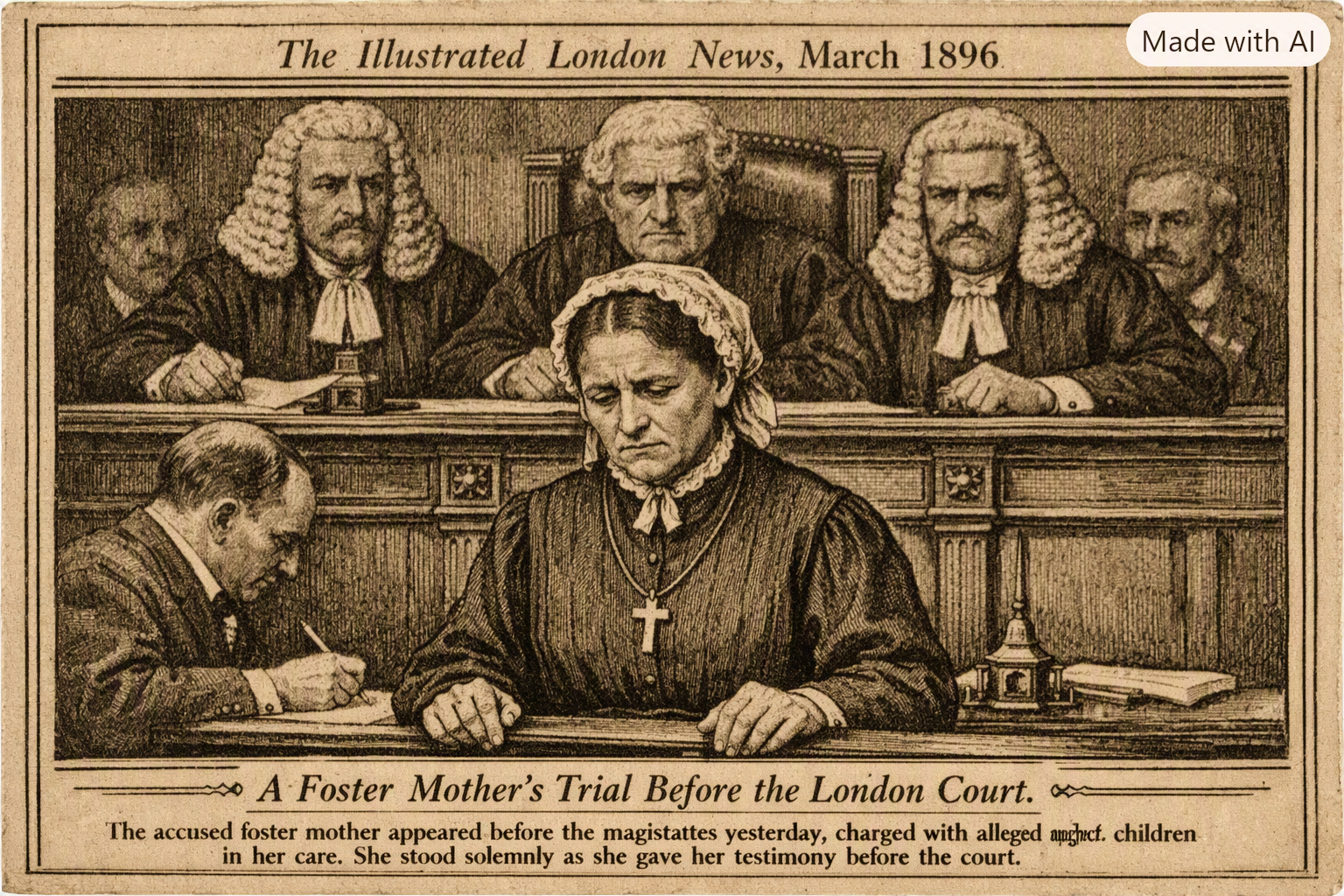
Ultimately, justice was eventually caught up with Dyer, taking the form of a minor detail by which she was linked to one of her fake names and addresses. Wrapping paper, in which the body of a child had been found, was analyzed under a microscope by Detective Constable Anderson, and a barely noticeable faded name and address were successfully deciphered. Ultimately, detectives were led directly to the door of Dyer’s house in Reading by this tiny fragment of evidence. Although her bloody work was confessed to by Dyer, madness was begun to be faked by her before the court at the Old Bailey. A pious martyr was played, by which the jury was attempted to be convinced that she was deprived of her senses, and thus full responsibility for her crimes was not borne by her. However, this defense was torn to shreds by the prosecutor, and this theater was seen through by the jury in not even a few minutes. Dyer was found fully sane and guilty of murder. On June 10, 1896, within the gloomy walls of Newgate Prison, hell was descended into by her for her actions at the end of the executioner’s noose.
The public horror, which was sparked by the Dyer case, was not faded into the void. In the following years, a number of laws, including the Infant Life Protection Act (1897) and the Children Act (1908), were passed by the British Parliament. Newly, a detailed report regarding any change in care or the death of a child under 7 years of age had to be received on the desk of local authorities within 48 hours. Finally, strict rules were established for the regulation of adoption and foster care, and the terrible phenomenon of “baby farms” was definitively cast into the abyss of history.
It is proven by the story of Amelia Dyer and the detectives by whom she was exposed that history is often found to be more thrilling than the best detective novel. A trace is left behind by every family, every name, and every generation. Forgotten heroes, ancient loves, surprising relocations, or carefully guarded family secrets are encompassed by it. Is it wondered by you what fates were unfolded in your family at the turn of the century? Where were your great-grandparents lived when history was being written? Let your ancestors not be allowed to fall into oblivion. A free consultation can be requested via the contact form at www.rodokmeny-schneider.cz, email, or WhatsApp.
Kateřina Schneiderová