
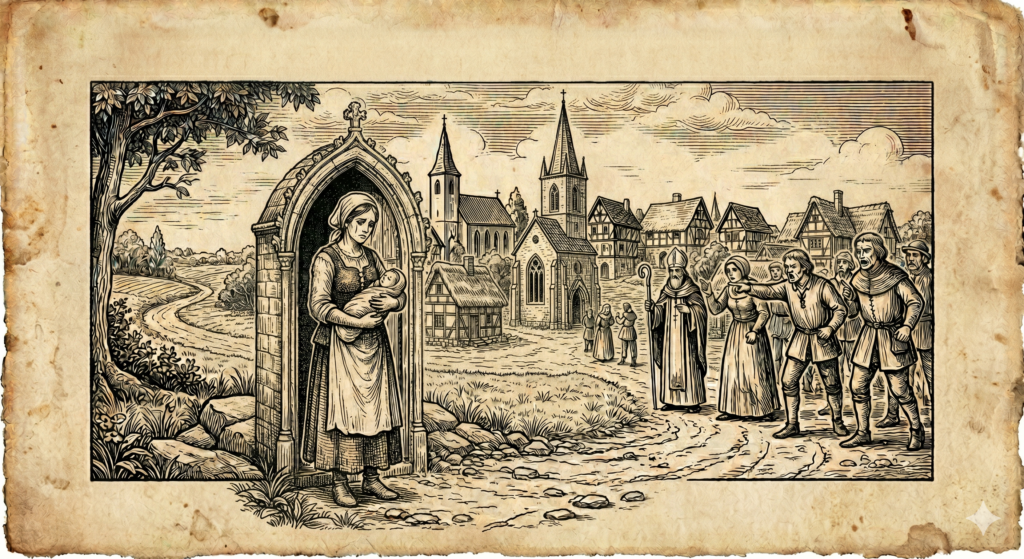
17. The Position of a Single Mother in the Past
Becoming a single mother was considered to be one of the harshest social downfalls for centuries. A girl by whom a pregnancy was conceived outside a legitimate marital union was not only perceived to have transgressed against the Christian morals of the time, but the very social order of the society of that era was disrupted by her as well. Suddenly, she was placed on the fringes of the community, her prospects for a good future were lost, and public humiliation as well as existential hardship were faced by her. Consequently, the fact that parenthood outside of marriage is currently considered to be a common and fully respected variation of family life is regarded as a “fresh novelty” from the perspective of long history.
How was the social condemnation of single mothers manifested? In the traditional rural and small-town society of the Czech and Moravian lands, harsh intolerance towards unmarried mothers was held in the past. Single mothers (especially young maids, farmhands, or daughters from poorer backgrounds) were confronted with strong public condemnation. Thus, these women were placed in a social vacuum. They were accepted by the community neither among the single “unblemished” youth nor among honorable married women. As a result, the offending daughter was often beaten by her own family out of a feeling of immense shame, and in extreme cases, she was even expelled from the house. Furthermore, if the girl was employed by someone as a servant, her job was immediately lost. It was common that, as a punishment for her transgression, the single mother was forced to stand before the Sunday worship service at the church entrance, and arriving believers had to be greeted aloud by her with the words: “You are welcomed to the church, a sin has been committed by me.” In the church, standing alongside other single maidens was no longer allowed for her, and she was publicly pilloried by the priest for her sin during the sermon. Moreover, the vocabulary by which these women were addressed by people clearly reflected their contempt. For instance, single mothers were referred to as fallen women or sinners. Their descendants were marked with a lifelong stigma of illegitimate origin, and they were called bastards, illegitimate children, or children of fornication. Consequently, this stigma was carried by the child throughout its entire life, and a better marriage or admission into a respected guild was often prevented by it.
Why did unwanted pregnancies occur? Despite the threat of cruel punishments and exclusion from society, an increase in the number of single mothers was observed in the past, especially at the turn of the 18th and 19th centuries. The causes were not rooted in a sudden decline in morality, but rather they were grounded in the harsh reality of the time and the absence of contraception (practices preventing conception), which was condemned by the church. A higher marriage age for men was frequently identified as a reason. Clerks, teachers, military veterans, or even heirs to a farm could only be married when a permanent position or a steady income was acquired by them (often up to around 30 years of age). Furthermore, the conclusion of a marriage was hindered by economic reasons. If sufficient property was not possessed by a couple, a marriage permit was simply not issued to them by the authorities and the nobility. False promises, which were used as a tactic of persuasion by men, were also common. Marriage was promised to the girl by many of them, but as soon as she became pregnant, they ran away (whether out of fear of responsibility, poverty, or conscription into the army). The deceived, abandoned woman was then left completely alone to face all the consequences.
It is shown by the history of unmarried mothers how harsh and uncompromising traditional society could be towards their fate. Public penance in front of the church, isolation from peers, and derogatory labels were experienced as the everyday reality of those by whom a pregnancy was conceived outside a legitimate union. Many of them were considered merely to be victims of poverty, strict laws of the time, or unfulfilled promises. During genealogical research, these records are now viewed by us through a new lens. That which was once considered to be a “shame” is currently perceived with deep respect as an expression of immense resilience. Every illegitimate child found in a family tree is regarded as a testimony to a woman by whom surrender was refused despite the whole world by which she was condemned.
Let the silent history of your ancestors be allowed to speak, and let the real human fates by which your bloodline was shaped be discovered. I can be contacted through the web assistant or via the contact form for an individual free consultation. Let the true story of your family be discovered at www.rodokmeny-schneider.cz .
Kateřina Schneiderová