
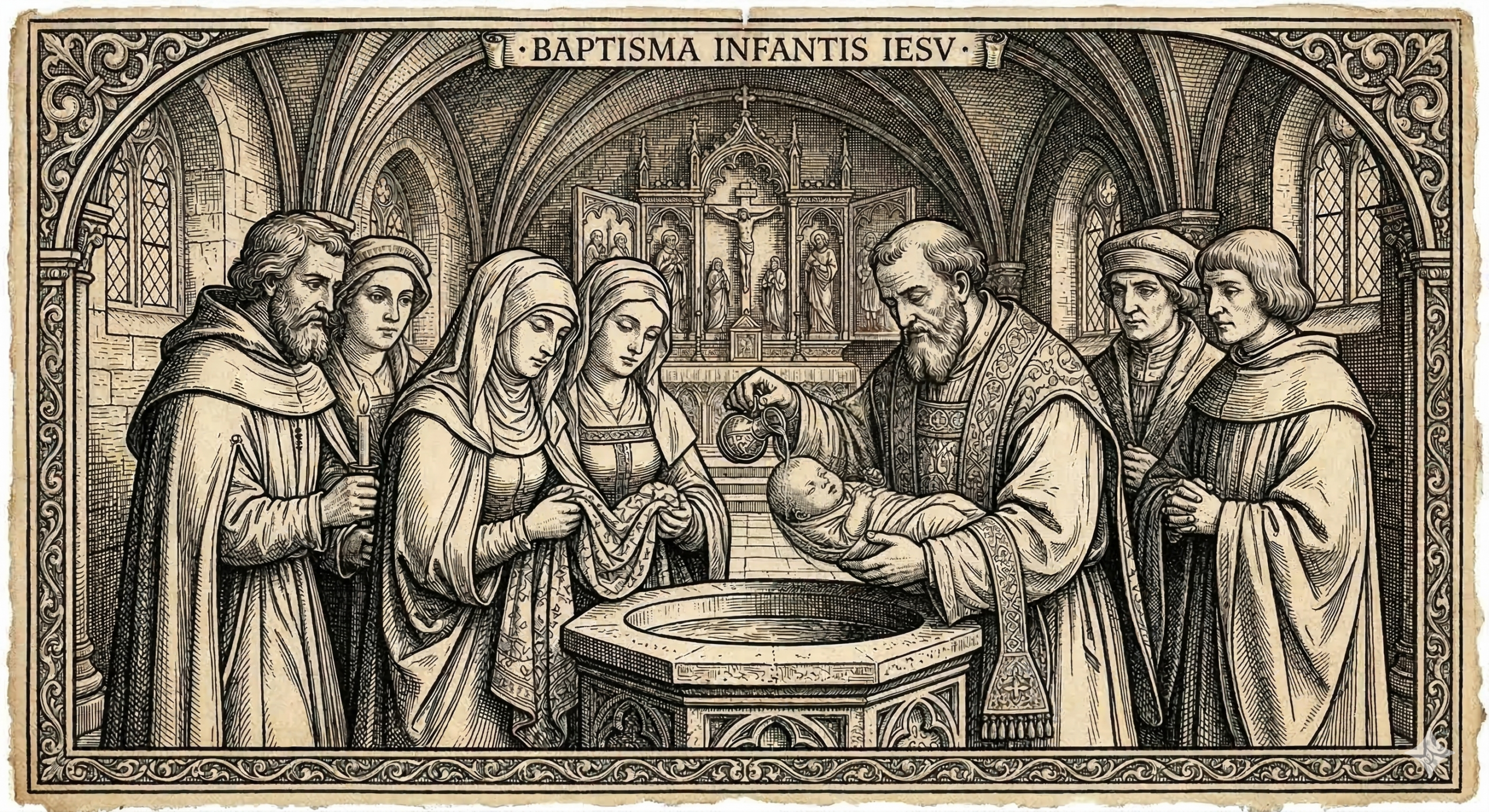
5. Baptism
Until the end of the 18th century, registers of births were kept as registers of baptisms, because only the date of baptism was recorded in them, not the date of birth. The baptismal ceremony, as a church act, had a clearly defined course. Its current form was established in the Bohemian and Moravian lands after the Thirty Years’ War during the period of re-Catholicization. Baptism was understood as a rite through which a person is cleansed of original sin, accepted as a child of God and a follower of Christ. Baptism is also the first step toward receiving other sacraments. A uniform baptismal procedure was applied to children born both within and out of wedlock. The difference lay only in the register entry; for illegitimate children, the father’s name was missing.
The baptizing priest was responsible for the correctness of the conducted ceremony, which took place exclusively in the church. The essence of the baptism was fulfilled when the priest declared, “I baptize you in the name of the Father, and of the Son, and of the Holy Spirit, amen“, and sprinkled the baptized person’s head with holy water. Priests were instructed to baptize only the children of parents who belonged to their parish and whom they knew well. The church wanted to have complete supervision over its flock, and in this way, it controlled the baptism of children whose parents (and the chosen godparents) were exclusively of the Catholic faith.
The baptism had to take place within a few days after the child’s birth. Especially in times of high infant mortality, there was a risk that the child would die unbaptized. In this case, it was permitted to perform an emergency baptism outside the church. If a priest was not available, a layperson (preferably a man) and, in extreme emergencies, a woman (most often a midwife) could perform the baptismal ceremony. Their task was to pronounce the given baptismal formula and use holy water, which could be replaced by ordinary water. Midwives were prepared by the priest for the possibility of an emergency baptism. If a child baptized in this way remained alive in the following days, it was brought to the church for the prescribed act of baptism in the presence of a priest. A similar procedure also took place in the case of abandoned newborns. The formal ceremony in the church was followed by a traditional feast in the home of the child’s parents. This is also why Sunday was a popular day for baptisms.
Kateřina Schneiderová