6. Heredity
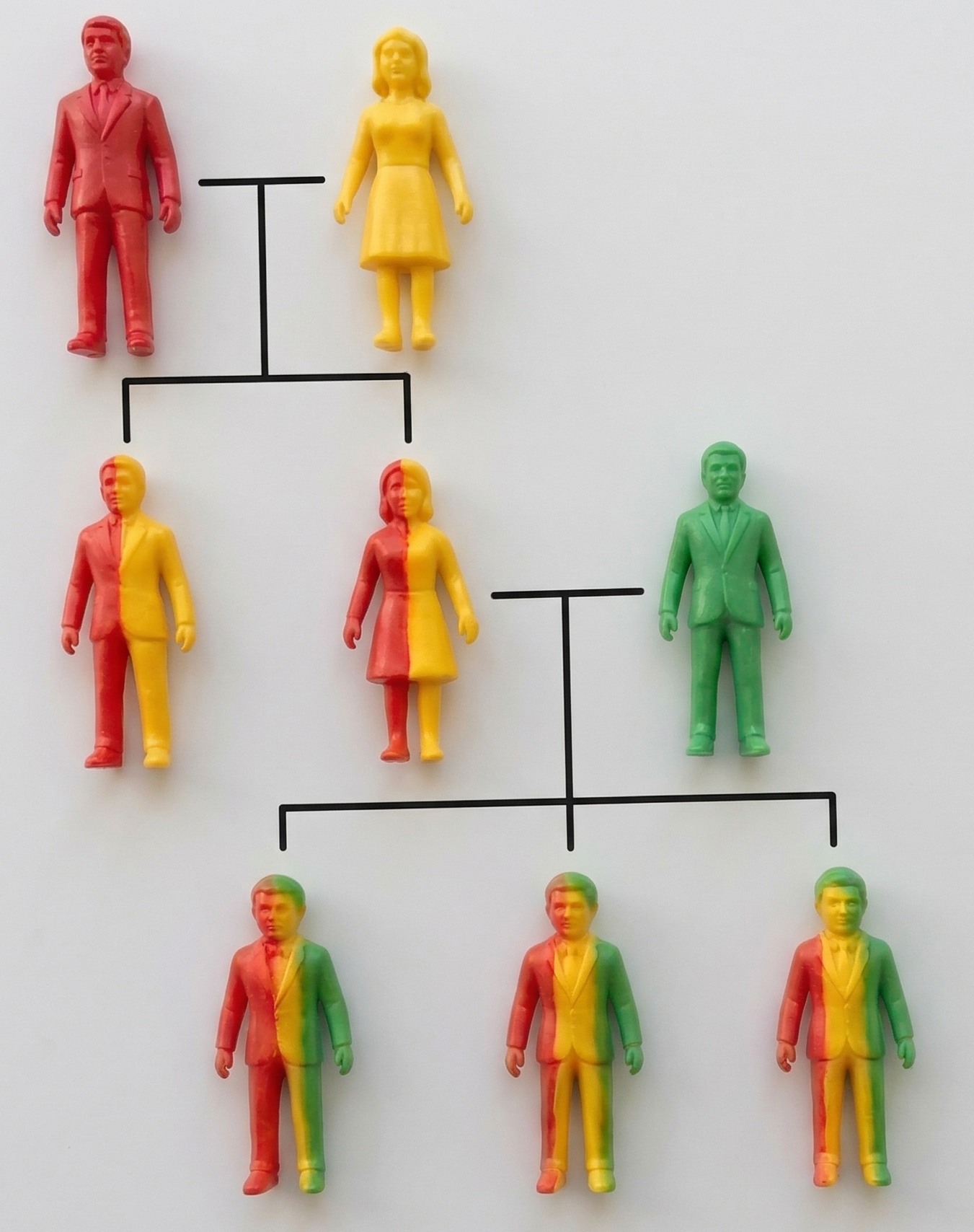
Heredity means the transmission of genetic information from parents to children. A child receives half of their genes (23 chromosomes) from their mother and half from their father. Full siblings do not have the same DNA because each child received a different part of the genome from their parents. The mother passes only an X chromosome to the child; the father passes either an X chromosome (a daughter is born) or a Y chromosome (a son is born).
Thanks to parental DNA, the offspring inherits physical appearance, blood types, but also predispositions to diseases. Types of inheritance determine how traits or diseases are passed from generation to generation based on the location of the involved genes. In autosomal inheritance, genes are located on non-sex chromosomes (1-22), and traits are inherited equally in both sexes. In this way, a person can develop cystic fibrosis, phenylketonuria, or sickle cell anemia. In gonosomal inheritance, genes are located on the sex chromosomes X or Y, and therefore this inheritance is sex-linked. Diseases associated with the X chromosome include Rett syndrome, hemophilia, and Duchenne and Becker muscular dystrophy. Well-known genetic disorders dependent on the number of chromosomes are Down syndrome (trisomy of chromosome 21) and Klinefelter syndrome (an extra X chromosome in males).
Changes in genes can also be caused by mutations, which create new genetic variants. Mutational changes occur at various levels, manifesting in a change in the structure or number of chromosomes, or a change in individual genes. Spontaneous mutations occur without an obvious external cause, most often due to a metabolic disorder in the organism. Induced mutations occur after exposure to physical, chemical, or biological agents with mutagenic effects. If germline cells are affected by a mutation, the disorder is passed on to the next generation.
Kateřina Schneiderová