
7. The Role of a Godparent
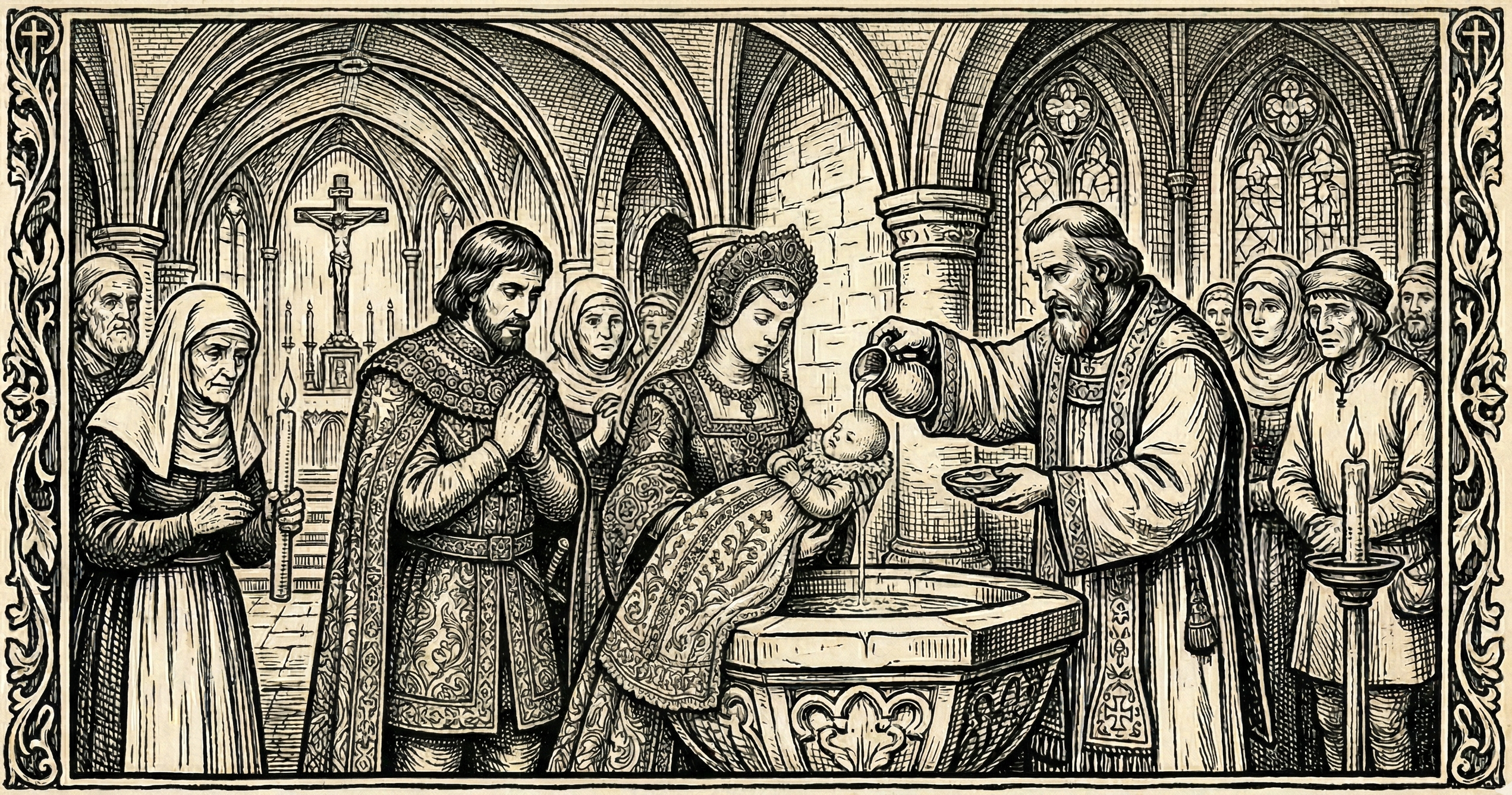
Asking someone to take on the role of a godfather or godmother at a child’s baptism was one of the deepest expressions of parents‘ trust. Refusing the request amounted to social and religious condemnation. In the past, the father’s presence at the baptism was not required, and the mother was considered unclean during the postpartum period (the confinement). In this situation, the godmother or midwife brought the child to the church for baptism, and the godparents assumed responsibility for the child. During the ceremony, the main godparent held the newborn in their arms, thereby jointly confirming a lifelong commitment. This spiritual kinship was equal to blood kinship. Another godparent carried a candle, which symbolically illuminated the soul of the baptized. It was common practice to choose a man as a godparent for a boy’s baptism and a woman for a girl’s baptism. During the ceremony, the child received a material gift from the godparent tucked into the swaddling blanket, usually a gold or silver coin.
The choice of a godparent fulfilled several requirements. From a traditional religious perspective, the godparent helped the parents with the child’s Christian upbringing and served as their moral compass. In the person of the godparent, the growing child had a safe haven, especially during adolescence. The godparent offered a different life strategy than the parents themselves. They were not on the front lines of daily upbringing, and therefore could resolve disputes with distance and perspective. From a practical point of view, the godparent was a social and material guarantee that the child would be cared for until adulthood if the parents died prematurely. The godparent committed to providing the orphaned godchild with housing, food, a dowry, or an apprenticeship in a trade.
A godparent was a practicing, adult, and mentally sound Catholic who either came from the wider family of the baptized or was a known and socially prominent figure. Both wealthy and poor people served as godparents. For reasons of social prestige, parents approached rich farmers, craftsmen, or representatives of local government (councilors, reeves/magistrates, lords, and their wives).
Kateřina Schneiderová