
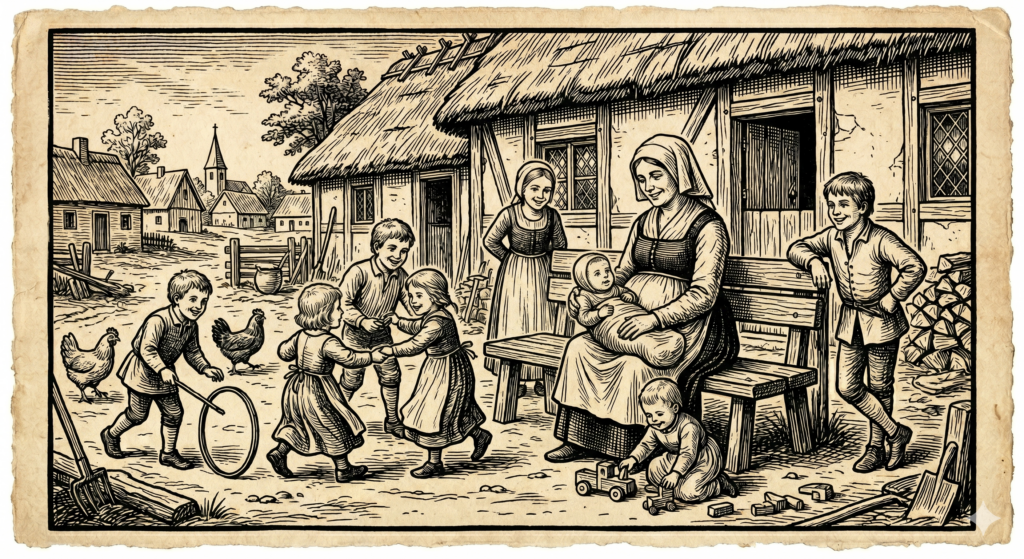
13. Birth Rate
Looking into the past and examining old parish registers reveals the lives of our ancestors, which stand in sharp contrast to today’s standards. The registry records reveal families with 8, 10, or even 12 children, but at the same time, they bear witness to the immense losses and pain that ruthlessly fell upon them.
In the period before the demographic transition (up to about the mid-19th century), the birth rate was extremely high. There were several reasons, but primarily it was due to unbelievable neonatal and infant mortality. It is estimated that about 20-30% of children died before reaching their 1st year of life, and another 10-20% did not survive early childhood. It was no exception for a mother to give birth to 10 children, yet only 4 would reach adulthood. Another cause of the high birth rate was the lack of contraception (practices preventing conception), which was also condemned by the Church. In the past, offspring did not merely represent the continuation of the family line, but from an early age, they functioned as an essential workforce in the fields and on the farm, or they became successors in the family trade and business. They were also the parents’ only “pension guarantee” for old age, who would otherwise remain without financial security. A decline in the birth rate only occurred at the end of the 19th century when improved hygienic conditions, medical discoveries, and a higher standard of living led to a significant reduction in child mortality.
The age at which mothers brought children into the world has undergone a radical transformation over the centuries. While our ancestors had their reproductive period stretched over a large part of their adult lives, young people today plan parenthood for a shorter and later period of time. To this day, the myth persists that in the past, women routinely married and had children at 15 or 16 years old, which is not based on the truth. In order for a young couple to marry and start a family, they had to be able to support themselves economically (run a farm or practice a trade). Therefore, common people often did not marry until between the ages of 20 and 28. An exception can be found in noble families, where “child marriages” were common for dynastic reasons. Ordinary women gave birth to their 1st child after turning 20 and their last at 40 to 45 years of age. The time gap between the births of individual children used to be 1-2 years. If children were born about a year apart, it meant that the previous child had died shortly after birth. In the registers, we often find cases where parents gave a newborn the name of an older sibling who had recently died. Full breastfeeding naturally protected the mother from another pregnancy, so the gap between surviving children was about 2 years.
Have you ever tried to imagine how your ancestors really lived? The past of our families wasn’t just black and white; it was full not only of everyday joys but also of hard trials, high child mortality, and unexpected turns in life. Do you know what secrets your bloodline hides? How many children were actually born to your ancestors, and how many of them lived to adulthood? At what age did your great-grandmothers start their families, and what challenges did they face back then? Entrust the search for your roots to a professional! I will gladly create your ancestry chart (family tree) and turn dry data from archives into a gripping story of your family. You will gain not only an overview with precise names and dates but also a deeper insight into who your ancestors were and how they lived.
Special offer: 4-generation ancestry chart (family tree) with 15 direct ancestors for the price of 4,485 CZK + siblings free of charge for each direct ancestor. An individual free consultation is available through my web assistant or the contact form at www.rodokmeny-schneider.cz .
Kateřina Schneiderová