10. Christian Names and Surnames
In the past, it was not necessary to use complex personal identification data as it is today. People knew each other in small communities, and to identify a person, their first name (Christian name) was sufficient. Surnames emerged much later. Originally, these were so-called bynames (supplementary nicknames), which were not hereditary and served, for example, to distinguish one Jan from another. The change came with the gradual growth of the population, migration to cities, and the development of state administration. In 1786, Emperor Joseph II issued a patent mandating the use of a permanent and hereditary family name. This was because rulers needed to collect taxes regularly and systematically, recruit soldiers, and keep records of property.
The newborn’s first name was confirmed at baptism. Children were named not only according to family tradition but also after saints or godparents who were supposed to be role models in their lives. Often, the name of a saint whose feast day fell around the child’s birth date was chosen. Ancestors understood time differently than we do today, and the baptismal name allowed them to estimate the approximate day of their birth. Baptismal certificates were not issued automatically. The priest only wrote out a baptismal certificate before a wedding, or when applying for an apprenticeship or entering military service. In times of immense child mortality, a child was also often given the name of a deceased sibling. Parents believed that in this way they would protect their next offspring from evil spirits and that the child would live to adulthood. Even in the past, the choice of first names depended on their popularity. Fashionable girls’ names included Anna, Rozina, Marie, Kateřina, or Dorota. Among boys’ names, Jan (John), František (Francis), Václav (Wenceslaus), Josef, or Vojtěch (Adalbert) stood out.
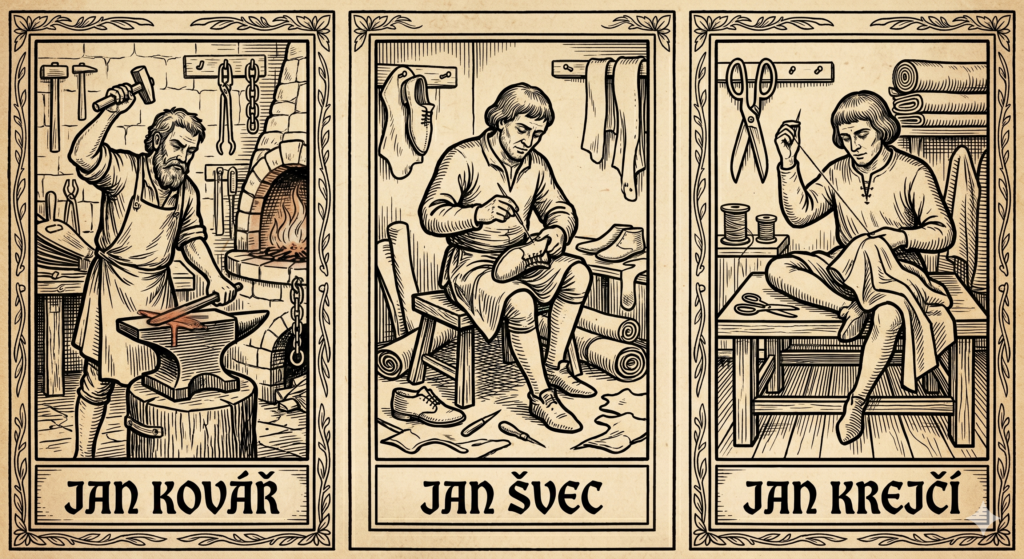
Surnames were created based on certain characteristics of the given person. This was either based on physical or character traits (Veselý/Happy, Zrzavý/Redhead, Kulhánek/Limping), by profession (Kovář/Smith, Švec/Shoemaker, Krejčí/Tailor), by origin and place of residence (Pražák/from Prague, Novotný/Newcomer, Němec/German), by the father’s first name (Kuboušek, Petr, Matějovský), or based on animals and nature (Myšák/Mouse, Sokol/Falcon, Dubenský). Due to strong German influence, it was common to Germanize Czech-sounding first names and surnames. When searching in the registers, you might find that the ancestors’ original surname was “Krejčí” (Tailor), which was later Germanized to “Schneider”.
The general history of surnames is fascinating, but only discovering your own roots gives these fragments of the past true meaning. What destiny is hidden behind your specific family name? Who were your ancestors, what trade did they master, and where did they come from? Don’t let your family’s history fade with time. Turn question marks into specific human destinies and have a professional, custom-made family tree created. Discover your ancestors and start your journey into the past today at www.rodokmeny-schneider.cz .
Kateřina Schneiderová