14. Y-Chromosome Testing – A Journey into the Depths of the Paternal Line
Genetic genealogy opens entirely new possibilities in family history research. While classical documentary research in parish registers can face insurmountable obstacles in the form of missing records or illegitimate children, answers are offered by DNA analysis where paper trails end. Furthermore, one of the most powerful tools in this area is Y-chromosome (Y-DNA) testing. Y-chromosome testing is a fascinating intersection of history and modern science. Therefore, for any researcher trying to deeply understand their family’s origin and unravel complex puzzles of the past, a reliable compass is provided, pointing the way through time directly along the footsteps of the founding fathers.
What is the Y-chromosome and how is it inherited? Human DNA is organized into chromosomes. A person’s gender is determined by 2 of them, the X and Y chromosomes. Women have the XX combination, whereas men are XY. Consequently, the Y chromosome is passed down exclusively from father to son almost without change. It is precisely this stable inheritance that makes Y-DNA an ideal tool for tracking the direct paternal line (father – grandfather – great-grandfather, etc.). Since surnames in our lands are inherited in the same way as the Y chromosome, this test represents a key for verifying family ties and exploring the origins of a surname.
What is discovered by Y-DNA testing? During Y-chromosome analysis, the focus of laboratories is placed on 2 main types of genetic markers (mutations): STR and SNP markers. The tests are designated (e.g., Y-37, Y-111, Big Y-700) according to the number of selected markers where changes occur. Currently, high-quality Y-chromosome analysis is offered by FTDNA.
1/ STR markers (Short Tandem Repeats)
These parts of DNA mutate relatively quickly (in the order of hundreds of years). Therefore, the testing of STR markers is crucial for historical genealogy. When these markers are compared with other men in the database, it can be determined whether a common ancestor is shared in the recent past (e.g., 5-15 generations ago), and thus a close relationship can be confirmed or refuted with high probability.
2/ SNP markers (Single Nucleotide Polymorphisms)
SNP-type mutations appear much more rarely and are highly stable. Moreover, they are used to determine a so-called haplogroup, which is a broad “genetic clan” sharing the same ancient ancestor. You will be taken thousands to tens of thousands of years into the past by SNP tests, and the migration routes traveled by your ancient ancestors from Africa to the place of current settlement will be shown.
When and why should Y-DNA testing be utilized in genealogy? If a dead end is reached by parish register research (e.g., due to destroyed books or secret paternity), the right direction can be shown by a match in the Y-DNA database with a man from another branch of the family. Groups where Y-DNA is compared by men with the same or similar surnames are also very popular worldwide. Consequently, it can be discovered whether all families with the same surname in a given country originate from a single common founder, or whether the surname was created independently in multiple locations.
However, certain limitations are possessed by Y-DNA. Testing is intended only for men, as the Y chromosome is not possessed by women (another male relative from the given line must be tested). Furthermore, the direct paternal line is examined exclusively by the test, and no information about your father’s mother, your mother’s parents, and other ancestors is provided (autosomal DNA testing is used for this purpose).
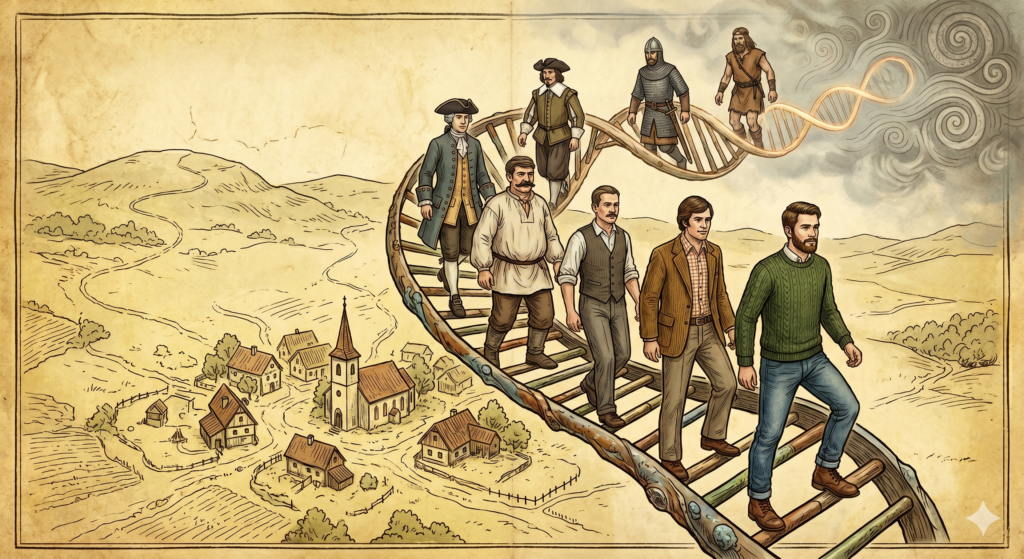
And what family history was discovered by me thanks to Y-DNA testing? During the genealogical research of the paternal Schneider line in the archives, the last documented ancestor, Jan Schneider (son of Ondřej Schneider) from Zbytiny in the Šumava region, who was married to Marie in 1665, was traced. Subsequently, it was shown by a comparison of Y-DNA from archaeological finds and a male descendant of the Schneider family that the ancestors of the Schneider branch were located in Regensburg, Bavaria, during the Copper Age, which is about 100 km as the crow flies from Zbytiny. The colonization of the wild Šumava forests had been ongoing since prehistoric times. However, the actual and systematic colonization of the mountainous areas was begun only at the turn of the 13th and 14th centuries under the rule of the Luxembourgs, when the borderland began to be populated on a large scale by German miners, glassmakers, and lumberjacks.
Uncover the secrets of your paternal line and the origin of your surname. Where parish registers end, DNA begins! Has a dead end been hit by your family tree? Classical documentary research can be complicated very quickly by missing records, destroyed books, or family secrets from the past. A solution is offered to you. Combine modern science with classical research and uncover the truth that is carried within you. Answers to your questions, including historical research, are provided. Therefore, take advantage of the special offer of a 10-generation chart of the direct paternal line (including wives) for 2990 CZK + free DNA testing consulting. I can be contacted via the web assistant or the contact form for an individual free consultation. Discover the true story of your family at www.rodokmeny-schneider.cz .
Kateřina Schneiderová