16. Y-Chromosome Haplogroups
One of the most important tools for the exploration of human origin is considered to be the analysis of the Y-chromosome and its specific variants – haplogroups. Consequently, a revolution was caused by the study of Y-chromosome haplogroups not only in population genetics and archaeology, but also in genealogy. Although traditional family tree construction based on parish registers is often terminated in the 17th century, this invisible barrier can be broken through Y-chromosome testing. Furthermore, even though the name of your Bronze Age ancestor will not be revealed by the test, it will be shown to you where he came from, by which routes his tribe travelled, and with which historical populations your deepest roots are shared.
What is a haplogroup? The Y-chromosome is characterized as unique because it is passed exclusively from father to son. During this transmission from generation to generation, minor harmless errors in DNA copying – SNP mutations – are occasionally made (more about SNP mutations can be read in the previous blog). Therefore, a haplogroup is defined as a group of men by whom the same genetic “signature” originating from a single common forefather is shared. All of today’s male lineages in the world are converged in ancient history at one single man. He is named Y-chromosomal Adam by scientists. However, the first man on Earth is not represented by him, but rather the common ancestor of all today’s living men in the direct paternal line is constituted by him. It is estimated that he lived in Africa roughly 230,000 years ago. From him, the family tree is then gradually branched into all today’s known haplogroups.
During migration from Africa to the rest of the world, new mutations were created, thanks to which the routes of prehistoric journeys can be tracked today. In the Czech Republic, dominance is held by haplogroups R1a (35%) and R1b (25%), which are followed by haplogroups I (10%) and E (5%).
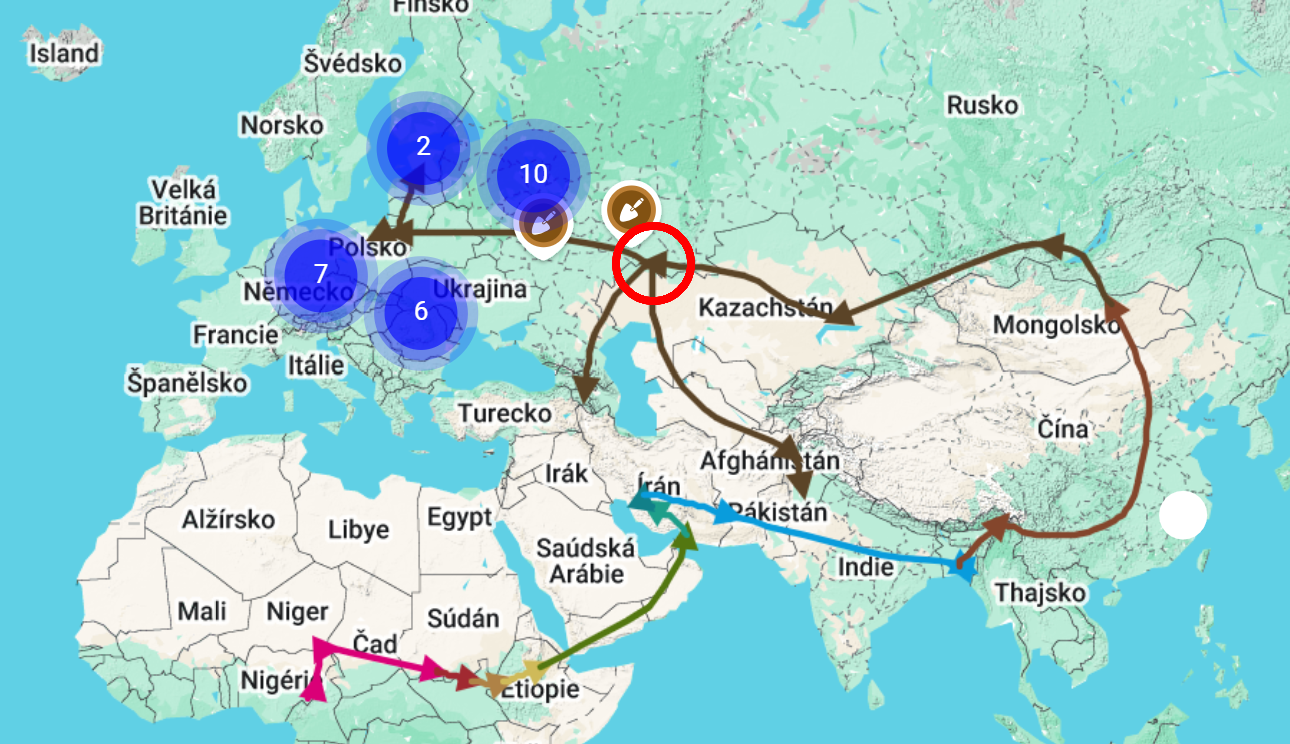
1/ Haplogroup R1a was separated from haplogroup R1 approximately at the end of the last ice age in the region of Pakistan or northern India, and it was expanded into Central Europe during the Bronze Age by the migration tribes from the eastern steppes. Moreover, it is recognized as the most frequent haplogroup in the Czech Republic, Poland, Ukraine, and Russia. In the picture, a graphical representation of the journey of the Schneider male line ancestors from “Adam” to the beginning of our era is displayed. Famous persons with haplogroup R1a are represented by Tom Hanks and Sir Francis Drake.
2/ Haplogroup R1b was separated from haplogroup R1 roughly 30,000 years ago in the region of Turkey and eastern Iraq, and it was spread into Europe by cattle herders during the Bronze Age. In addition, its frequency is found to be highest in Western Europe and, due to large emigration waves of the population in the 19th century, also in North and South America and Australia. Haplogroup R1b was possessed by Tutankhamun, Louis XIV, or the Russian Tsar Nicholas II.
3/ Haplogroup I is considered unique because it was formed directly in Europe, and the descendants of the oldest hunter-gatherers, by whom the ice age was survived here, are represented by it. It is divided into two main subgroups. The first subgroup is called I1 (Nordic); it is found in Scandinavia and is associated with Germanic tribes. Furthermore, this haplogroup was detected, for instance, in L. N. Tolstoy. The second subgroup, I2 (Balkan/Eastern European), is highly widespread in the Balkans, and its presence was proven by testing in Napoleon III or Nikola Tesla.
4/ Haplogroup E represents the last major migration from Africa to Europe, where it was brought by the journey of Neolithic farmers from Asia Minor. It is commonly found in North Africa, the Middle East, and Southern Europe. For example, haplogroup E was had by Napoleon I Bonaparte and Albert Einstein. Has that discrepancy also been noticed by you? Why is a different haplogroup possessed by Napoleon I than by his nephew Napoleon III, even though the same paternal line (haplogroup E) should be shared by both? The explanation is deemed simple. Somewhere between Napoleon I and Napoleon III, a non-paternity event occurred – a disruption of the paternal line. In layman’s terms, an illegitimate origin was shared by Napoleon III or his father.
How is the history of your lineage revealed by DNA? Has it ever been wondered by you where your ancestors originate from? You can be led by paper registers a few centuries into the past at most. Nevertheless, the door to thousands of years of family history will be opened to you by genetic genealogy, specifically by the analysis of the Y-chromosome. Why should DNA be combined with a classical family tree? While names and places are given to you by a classical family tree, a broader story is provided to you by the analysis of haplogroups. It is a story of migration, survival, and ancient populations by which who you are today was shaped. Is it wondered by you what historical blood flows in your veins? A combination of classical genealogical research with the interpretation of DNA test results is offered by me. Let the story of your family from the earliest times be uncovered together! Furthermore, the special offer of a 10-generation chart of the direct paternal line (including wives) for 2990 CZK + free counseling regarding DNA testing should be utilized. I can be contacted through the web assistant or via the contact form for an individual free consultation. Let the true story of your lineage be discovered at www.rodokmeny-schneider.cz .
Kateřina Schneiderová