18. Mitochondrial DNA Testing
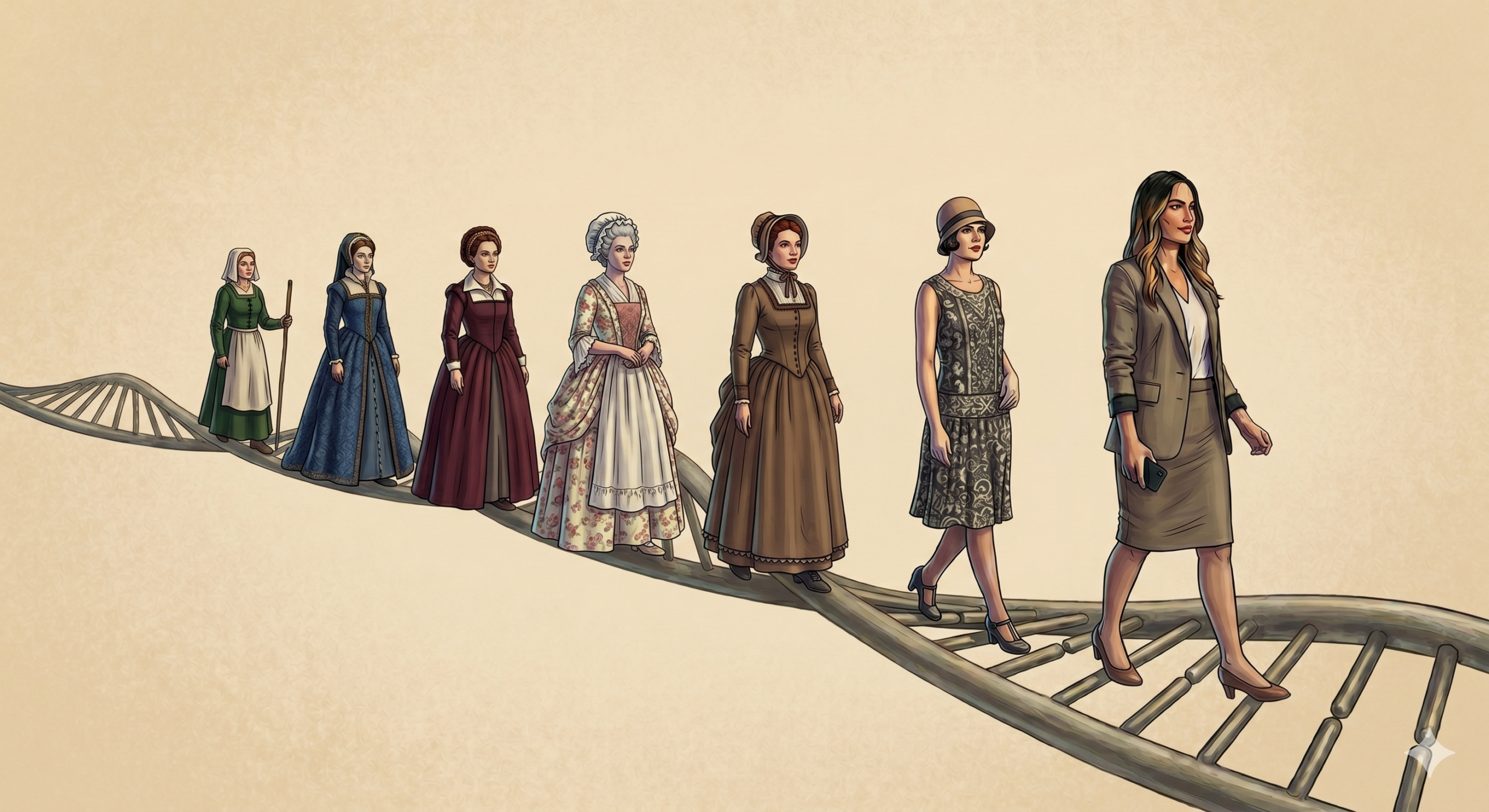
The maternal line is not inherited via the X chromosome, but rather it is passed down thanks to mitochondrial DNA (mtDNA). Furthermore, it is located outside the nucleus within the mitochondria, which are characterized as cellular energy reserves required for the functioning of the organism. In contrast to nuclear DNA, which is inherited half from the mother and half from the father, mtDNA is inherited exclusively along the maternal line. It is passed on by the mother to all her children, but it can only be transmitted to the next generation by daughters. Thus, although mtDNA is inherited by a man from his mother, it is no longer passed on to his descendants by him. Today, a key tool is represented by the testing and analysis of mtDNA not only in medicine and forensic sciences, but primarily in the exploration of the deep history of our ancestors (paleogenetics).
What advantages are offered by mtDNA testing? In contrast to Y-chromosome testing, which is intended solely for men (more can be read in the article on Y-DNA), individuals of both sexes can be tested. Because hundreds to thousands of copies of mtDNA are found in every cell (as opposed to merely two copies of nuclear DNA), mtDNA is rendered much more resistant to degradation. Therefore, it is utilized for the identification of old skeletal remains or in cases where nuclear DNA has already been destroyed (for example, by the effects of high temperatures, ionizing radiation, and chemical substances). Consequently, the direction of their research is either confirmed or refuted by genealogists using the obtained results. Indeed, when the maternal line is examined, a fundamental problem is encountered regarding women, namely the change of their surname after marriage.
A certain disadvantage of mtDNA testing is rooted in its low usability for genealogical research, as it is recombined even less than Y-DNA and is thus kept practically unchanged for tens to hundreds of generations. A specific haplogroup is determined for the tested person by the mutations identified in the laboratory. Haplogroups are considered to be sorts of branches on the grand family tree of humanity, by which convergence at a common prehistoric ancestor is reached. In the case of mtDNA, this is represented by the so-called Mitochondrial Eve. Furthermore, the evolution of the human species and its migration routes are allowed to be researched by scientists through these results. The most frequent mtDNA haplogroup in the territory of the Czech Republic is identified as haplogroup H, while haplogroups U and T are found to a lesser extent.
Is it wondered by you where your ancient foremothers originate from? You can only be led a few centuries into the past by common historical records; however, new horizons are opened to you by the combination of classical research and genetic testing. Let the story written in your mitochondrial DNA (mtDNA) be read, and let your family tree be enriched with a fascinating chapter from the dawn of humanity, or let its accuracy be confirmed. Moreover, having a classical chart of the maternal line compiled is considered an important step towards success in the search for family history, so that your results can be compared. Let your true roots begin to be discovered today at www.rodokmeny-schneider.cz .
Kateřina Schneiderová