
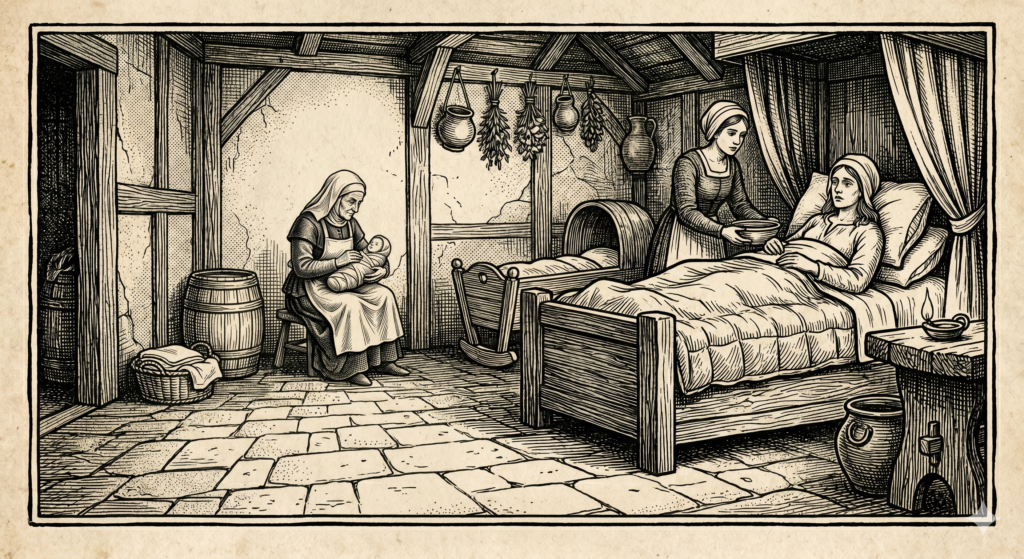
15. The role of the midwife
In the past, childbirth was not only considered to be the expectation of a new life, but it was also perceived as a highly risky event with an uncertain outcome. The vast majority of children were born at home, and the main (and often the only) support of the laboring woman was provided by the midwife. Consequently, a true revolution was brought to obstetrics only by the 20th century. Furthermore, with the development of modern medicine, births began to be moved from the homes of mothers to maternity hospitals, and midwives were officially transformed into educated obstetric assistants.
The term midwife is used to denote a traditional female profession aimed at assisting women during childbirth and the postpartum period. Until the mid-18th century, the practice of midwifery was often regarded more as a rescue from begging than as a respected profession. Midwives were mostly constituted by older women, often poor widows, by whom several children had been delivered themselves, and thus basic experience was possessed. Mostly, reading or writing was not mastered by them, and their reward for assistance at birth was deemed miserable, frequently provided only in the form of goods in kind. Moreover, a number of skills had to be mastered by a midwife. Not only did the course of childbirth have to be managed to a successful conclusion, but an emergency
baptism had to be performed correctly as well. Furthermore, if a child was dying and it could not be managed by the priest to arrive in time, the newborn had to be baptized by the midwife so that its soul would not be condemned to hell. Their knowledge was passed down orally from generation to generation by these women. An older midwife was often accompanied for years by an apprentice before independent work could be started. If more serious complications occurred, it was often not known by the midwife what to do. Consequently, instinct, herbs, or established superstitions were relied upon. Due to the high mortality rate of mothers and newborns, these women were frequently accused of magic and witchcraft during the times of witch trials.
A fundamental turning point was brought about by the reign of Maria Theresa and Joseph II. It was realized by the state that the population (and thereby the amount of collected taxes) and the army were being weakened by the high mortality of children. Midwifery was turned into a state-controlled and recognized field. The midwife was examined regarding her knowledge by a pre-designated physician. Also, a certificate from the local priest had to be provided, by which it was confirmed that a proper Christian life was lived by her, and she was temperate and honest. If the exam was passed by the woman, a solemn midwife’s oath was taken. During it, loyalty to the sovereign was promised, assistance to the poor and rich alike without distinction was pledged, and it was sworn that abortion-inducing means would never be used. A badge was acquired by a successful midwife (she can be recognized by the note in the register as “examined”), by which she was distinguished from unqualified women. High financial fines or imprisonment were faced by the latter for the illegal practice of the trade. By the 19th century, university courses had to be completed, anatomy had to be learned, and a diploma had to be obtained by a midwife for practice in cities.
Has it ever been pondered by you how incredibly fragile life was in the past? Up until the 19th century, their first birthday was not lived to see by almost a third of children. Births were conducted in harsh conditions at home, often only with the assistance provided by midwives. Without modern medicine, antibiotics, and with the constant threat of puerperal fever, every new life was considered a small miracle. Everyone of us is represented as living proof of the amazing resilience of the generations by which we were preceded. Let the forgotten stories hidden in old parish registers be revived, and let it be discovered who the people really were to whom you owe the fact that you are here today. Let the lid of history be peeked under with us. Your roots will be uncovered, and a family history will be compiled, which will be turned into a proud heritage for your children and grandchildren.
Special offer: A 4-generation chart (family tree) with 15 direct ancestors for the price of 4485 CZK + siblings provided for free for every direct ancestor. An individual free consultation can be arranged through my web assistant or the contact form at www.rodokmeny-schneider.cz .
Kateřina Schneiderová