30. Elementary Education
The smell of chalk, a fixed schedule, and colorful textbooks – this is what today’s elementary school looks like, something we take for granted. Yet just a few centuries ago, education was a luxury reserved for only a chosen few, while the vast majority of children spent their days in the fields or in artisans’ workshops.
In the Middle Ages, formal instruction was reserved only for future priests and a narrow stratum of the nobility. Lessons were taught in Latin, which ordinary people did not understand, and the foundation of education was rote memorization without a deeper comprehension of the text. The vast majority of the population thus remained completely illiterate. Within families or guilds, only practical skills and crafts were passed down from generation to generation. A partial shift in education slowly began to arrive with the Renaissance and Humanism (16th and 17th centuries). The Reformation pushed for every believer to be able to read the Bible for themselves, which led to the founding of schools in the countryside as well. Teaching began in native languages, and the ideas of John Amos Comenius (such as learning through play and visual instruction) gradually gained ground. However, the role of a village teacher carried no social prestige. Teaching was often done by discharged soldiers, poor students, or craftsmen who merely earned extra money by working at the school during the winter months.
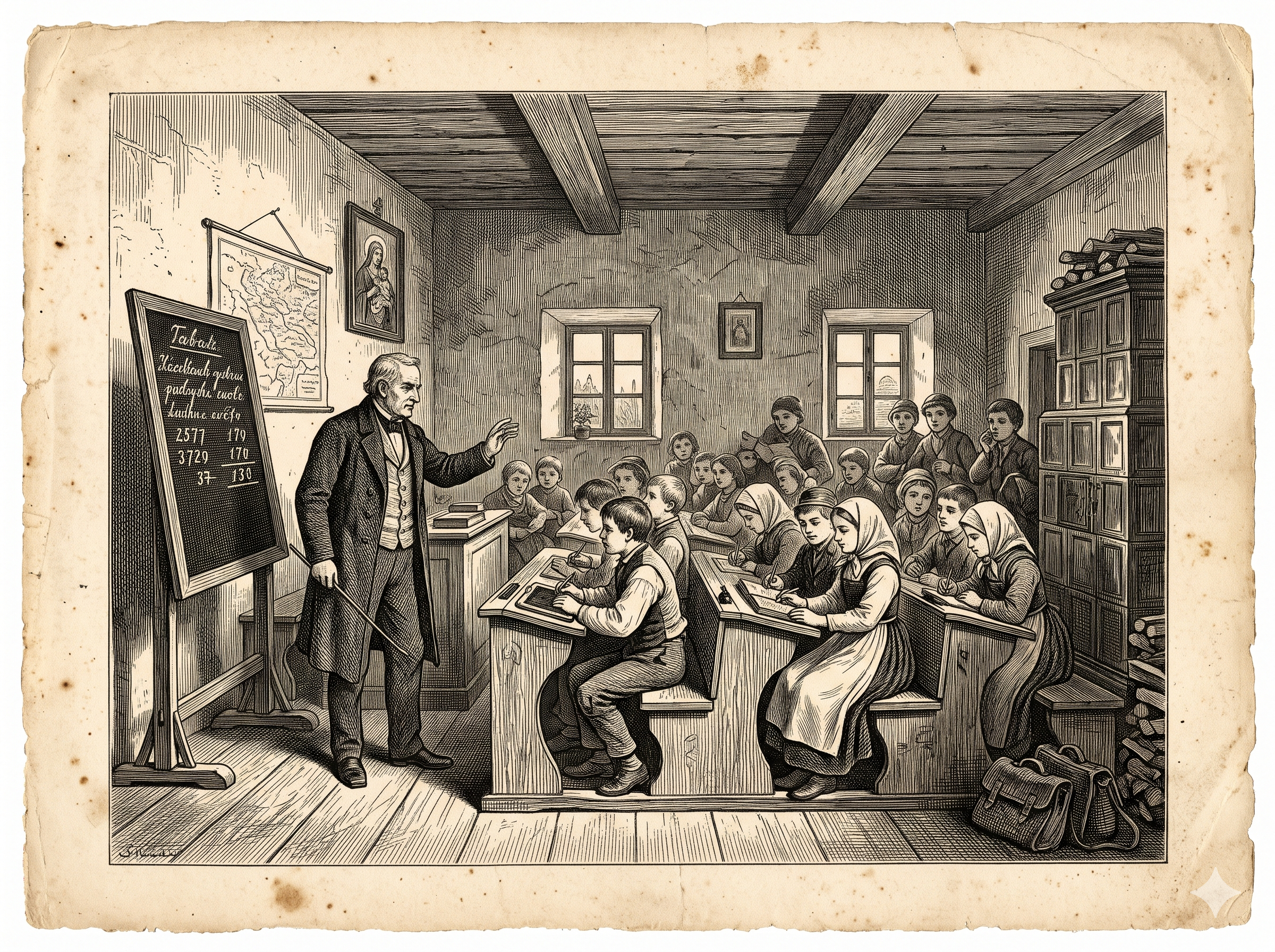
Fundamental changes to the elementary education system were not brought about until the reforms of Maria Theresa in 1774. Compulsory school attendance was introduced for all children aged 6 to 12, regardless of gender or social status. So-called trivial schools were established, where reading, writing, arithmetic, and religion were taught. The advantage of this system was that within a few decades, illiteracy dropped significantly across the entire population. The disadvantages lay in the difficulty of enforcing regular attendance (children had to help out on the farm from spring to autumn) and the lack of suitable school buildings (classes were not infrequently held in the local tavern, for instance). The teacher received a miserable salary, and his survival depended on payments in kind provided by his pupils’ parents (firewood, eggs, or grain).
The 19th century brought the Industrial Revolution, which demanded a literate and skilled workforce. The state passed a law extending compulsory schooling to 8 years, curtailed the church’s influence over teaching, introduced secular school supervision, and ensured professional training for teachers at teacher training institutes. Schooling truly reached all strata of society, and authorities began to strictly penalize truancy. Pupils were divided into classes according to age and knowledge. The school system became dominated by strict drill and the demand for absolute obedience. Female teachers were forbidden to marry during their teaching careers. This teacher celibacy meant that if a woman wanted to start a family, she had to leave the teaching profession for good. The regulation stemmed from the belief that a married woman would not be able to devote herself fully to the children during lessons.
At the beginning of the 20th century, elementary education became further democratized and modernized. Insights from modern psychology began to make their way into education. Mechanical rote learning slowly receded, and emphasis was placed on developing critical thinking and creativity. However, modern pedagogical trends gradually took hold only in cities. In small rural multi-grade schools, where a single teacher often taught children of several grade levels simultaneously in one room, old authoritarian methods persisted much longer.
Old report cards, apprenticeship certificates, and school chronicles are a treasure that can bring your family’s history to life. If you have similar keepsakes at home, or if you would like to look into the fates of your ancestors, I will gladly take on the research for you. Find out where you come from and what stories were written by those who came before you. You can order the services directly for yourself, or delight your loved ones with an original gift voucher for genealogical research. Request a free consultation via the contact form, email, or WhatsApp, and let us begin telling the story of your lineage together.
Kateřina Schneiderová