12. Autosomal Testing
Autosomal DNA testing is currently considered an effective and affordable way to explore and confirm your genetic roots. Why is it advisable to test DNA from a genealogical perspective? For instance, due to the absence of written records (parish registers, land registers), DNA might be the only link to your lost ancestors. The test can find living relatives with whom you share a portion of your DNA, thus connecting your family history. The test can also confirm whether the paper records about your ancestors are accurate (revealing a secret adoption or an illegitimate child). A test can even verify passed-down family legends about a Swedish soldier, an illegitimate child of a nobleman, or a great-aunt from America. A prerequisite for success is having a basic pedigree chart (family tree) created; otherwise, the testing will not fulfill its purpose.
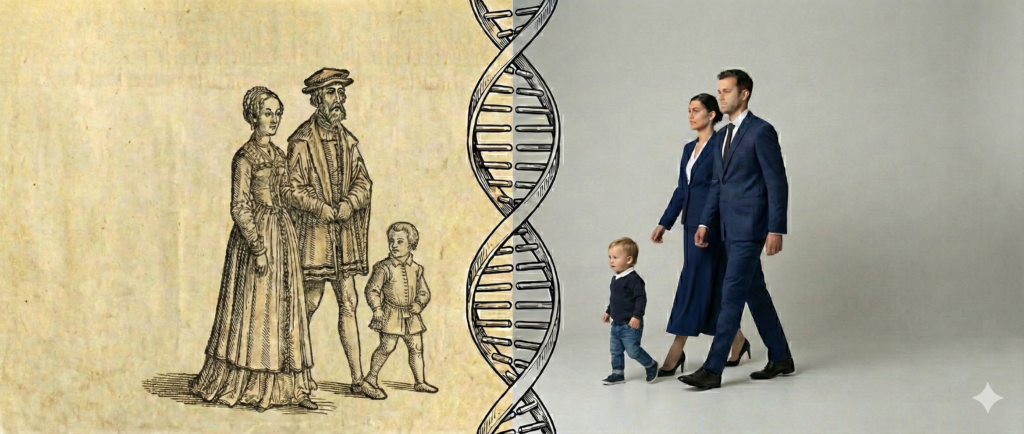
Human DNA consists of 23 pairs of chromosomes. One pair forms the sex chromosomes (X and Y), and the remaining 22 pairs are autosomes, which this type of test focuses on. According to the laws of heredity, we receive exactly 50% of our autosomal DNA from each of our biological parents. Before the DNA is passed on to the next generation, it gets “shuffled” (recombination). This means that the portion of DNA we share with our grandparents, great-grandparents, and other more distant ancestors shrinks with each generation and is distributed entirely at random.
For the purposes of genealogy, it is not worthwhile to test in local laboratories, but rather with large global companies that have massive user databases (otherwise you would have no one to compare your DNA with). The most comprehensive user database in Europe (and in the Czech Republic) is offered by MyHeritage. Other major players in the market are FamilyTreeDNA, AncestryDNA, and 23andMe. The results of an autosomal test are most commonly used to search for genetic relatives. Your results are compared with a broad database of results from other tested users. If you share sufficiently long matching segments of DNA (measured in units called centimorgans) with someone, the computer system will identify you as relatives. An ethnicity estimate is also part of the results. By comparing your DNA with reference samples of populations from around the world, testing companies can estimate the geographical areas your ancestors came from. The advantage of autosomal DNA testing lies in covering all family lines, and it is used for both men and women. Conversely, the disadvantage of the test is that the accuracy of finding relatives is possible up to the 6th to 8th generation; thus, it is not used for tracking human prehistory. Specialized Y-DNA and mtDNA tests serve that purpose.
And what family history did I discover thanks to DNA testing? The test results connected me with the lost branch of my great-grandmother. Her origins were not talked about in our family because she came from the Sudetenland, and over time, the family memory faded. Her ancestors came from Germany in the 13th century at the invitation of the Bohemian ruler to settle and cultivate the inaccessible areas of the Orlické Mountains. They lived in the same place for several centuries, but because of their German nationality, they were all expelled to Germany after World War II. Only she was able to remain in Bohemia because she had married my great-grandfather before the war and, through the marriage, assumed his Czech nationality as well.
Do you have blind spots or forgotten secrets in your family history? Combine modern science with honest genealogical research and get the most comprehensive view of who you are and where you come from. I offer answers to your questions, including historical research. Contact me through my web assistant or via the contact form for an individual free consultation.
Kateřina Schneiderová