
26. The Fate of Abandoned Children
It is shown by the history of Czech foundling hospitals how a difficult trial was gone through by a society by which a balance between the social helping hand of the state and the protection of the fundamental rights of the smallest ones was slowly being learned to be found. In the 18th and 19th centuries, key institutions for the care of abandoned newborns and infants were represented by foundling hospitals. Illegitimate children, by whom more than half of the inmates were constituted, were targeted as the main group; however, during periods of economic crises and ongoing industrialization, children from legitimate unions or double orphans were also received by foundling hospitals to an increased extent.
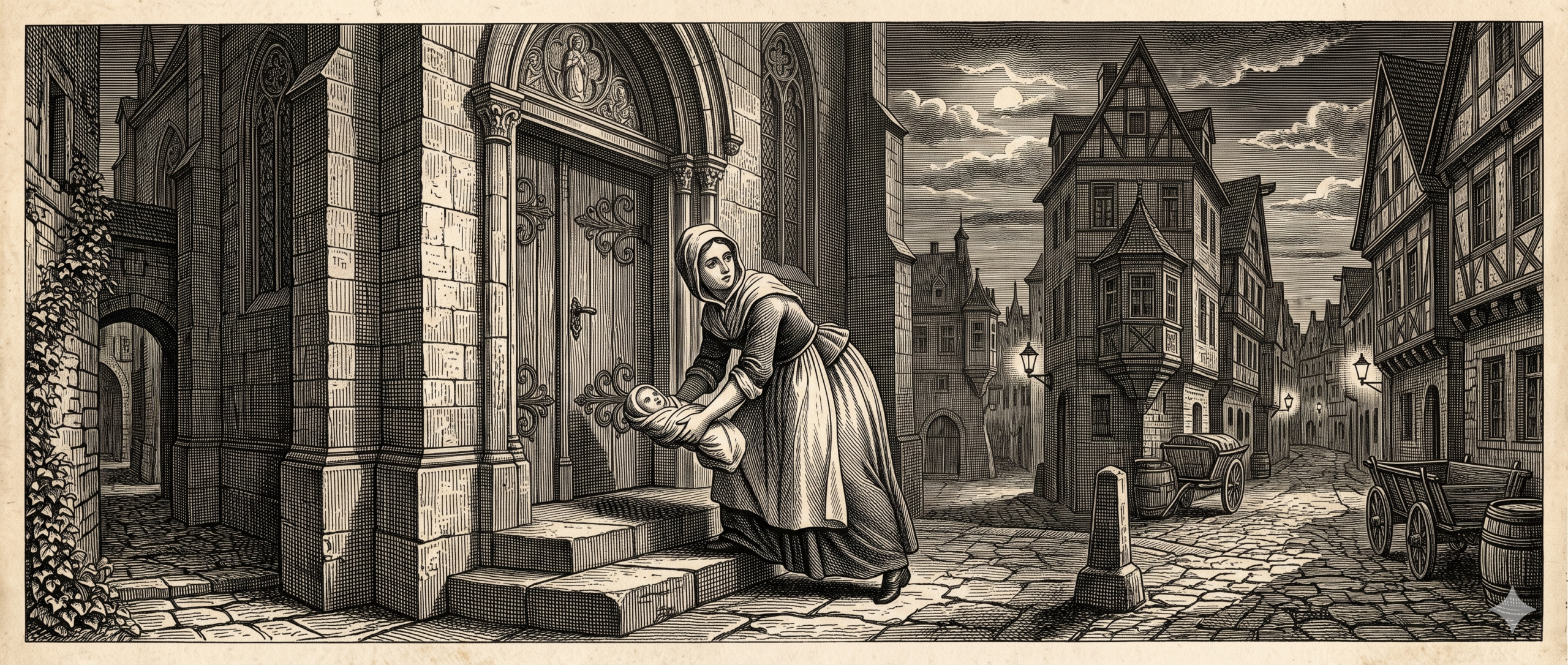
What Children and Under What Circumstances Were Brought into Foundling Hospitals? The largest part of the inmates was constituted by children born outside of marriage. In the past, an enormous social stigma, poverty, and the loss of livelihood were faced by single mothers. If a pregnancy was conceived by a single girl, her job and thus also the roof over her head were immediately lost by her. With an illegitimate child in her arms, no chance to secure basic life necessities was possessed by her. No social benefits or the reliable collection of alimony from the fathers of the children were entitled to by women. For many of them, the abandonment of the child in a foundling hospital was considered the only way by which hunger, a miserable existence, and the inability to work could be avoided. Furthermore, a significant part of the inmates was also formed by children who were anonymously abandoned (“found”) in public places without any documents regarding their origin. Newborns were abandoned by desperate mothers or third parties on church thresholds, in the hallways of houses, on city walls, in parks, or on the beds of wagons.
Although foundlings and illegitimate children were primarily served by foundling hospitals, children from legitimate marriages were also placed here in times of greatest need. During the 19th century, with the development of the Industrial Revolution, cities were flooded by hundreds of thousands of people in search of work. Appalling conditions were lived in by them, and basic life necessities were often not able to be covered by their wages. If another child was born into a family by which five or six hungry mouths were already possessed, and jobs were lost by the parents, it occurred that even a child from a proper marriage was sent to the foundling hospital. Alternatively, if death was met by the mother during or after the birth of the child, and inhuman conditions were worked in all day by the father in a factory, full-day care for the newborn could not be secured by him as a result. In such cases, the child was renounced by the parents in the hope that it would be taken care of in the institution.
How Was the Handover of the Child to the Institution Conducted? Initially, it was deemed sufficient for the child to be anonymously placed into a receptacle. In the 18th and early 19th centuries, special revolving cabinets built into the walls of foundling hospitals and hospitals were utilized for this purpose. At night, a bell was rung by the mother, the cylinder was turned, and the child was disappeared inside. In this way, hundreds of children were received by the institutions annually without the mother’s name being learned by anyone. Sometimes, at least a note with the child’s first name, date of birth, or a remark stating whether it had been baptized, was slipped into the swaddling clothes by the mothers. It was frequently explained by the women in the message that the child was being abandoned due to misery and shattered living conditions, not out of cruelty. Memorial items (halves of coins and ribbons, or medallions of saints) were also included in the swaddling clothes of some children. The second half of the item was kept by the mother in the hope that her child would be recognized by her in the future (if her life situation was improved) by this “mark.” In the second half of the 19th century, anonymous receptacles were begun to be abolished en masse by the authorities. It was targeted by these measures that women would be forced to claim their children, and thus their reckless abandonment would be prevented. The child had to be brought personally by the mother to the institution, where she was subjected to a strict interrogation. A protocol was drawn up by the officials, the child’s father was investigated (for the recovery of care costs), and her misery had to be proven by the mother. However, this bureaucracy and public disgrace were feared by many women to such an extent that birth was rather given in secret, and children were covertly abandoned in the field, by which further tragedies were led to (more can be read in the previous article).
Are forgotten fates, unknown ancestors, or traces of dramatic events in the past hidden by your family story? The search for ancestors is not merely considered a sum of dates and names; rather, it is recognized as the discovery of real human fates, which were often marked by poverty, social pressure, and the cruel rules of that time. Let our professional genealogical services be utilized, and let the tracks of your own history be followed with us. Let a free consultation be requested via the contact form, email, or WhatsApp.
Kateřina Schneiderová