
22. Child Support for Illegitimate Children
A fascinating view of the development of morality, family law, and social care is presented by the history of legal responsibility for illegitimate children. Furthermore, a radical transformation was undergone by the father’s obligation to financially secure his dependent offspring from the Middle Ages to the first half of the 20th century. While a matter of morality and church decision-making was dealt with in the Middle Ages, the payment and enforcement of alimony were turned into a firm part of the state legal system in the modern era, by which the protection of children regardless of their parents’ marital status was ensured.
In the Middle Ages and the early modern period, the issue of illegitimate relationships was regulated by canonical and customary law. Severely restricted rights were possessed by illegitimate children (more about them can be read in the previous article), both in the area of inheritance and social application. Although extramarital sex was condemned by the church as a sin, it was insisted upon that moral and material responsibility for the fruit of his concubine be borne by the father. Consequently, the father was obligated to contribute to nourishment and upbringing (the so-called alimentum), and these disputes were handled by ecclesiastical courts. Paternity had to be proven by the single mother, and thus, spicy testimonies regarding everywhere conception had occurred (including the names of witnesses by whom it was unwittingly stumbled upon) were preserved in church protocols. If paternity was determined by the court, the men were ordered to pay financial support or to have the livelihood of the mother and child secured during the puerperium. Until the end of the 18th century, a modern system of regular monthly alimony was not existed, so the financial issue was most frequently resolved in these two ways. The first option was represented by forced marriage. If both individuals were single and from a similar social class, hard pressure was applied to them by the church so that a marriage would be entered into and the child would thus be legitimized. The second option was meant as the payment of a severance sum. If the father was married or from a higher class, a one-time lump sum was paid to the mother by him. The costs of childbirth and partially of upbringing were meant to be covered by it. Thereby, all official responsibility for him was ended, and the mother and child were left to their fate.
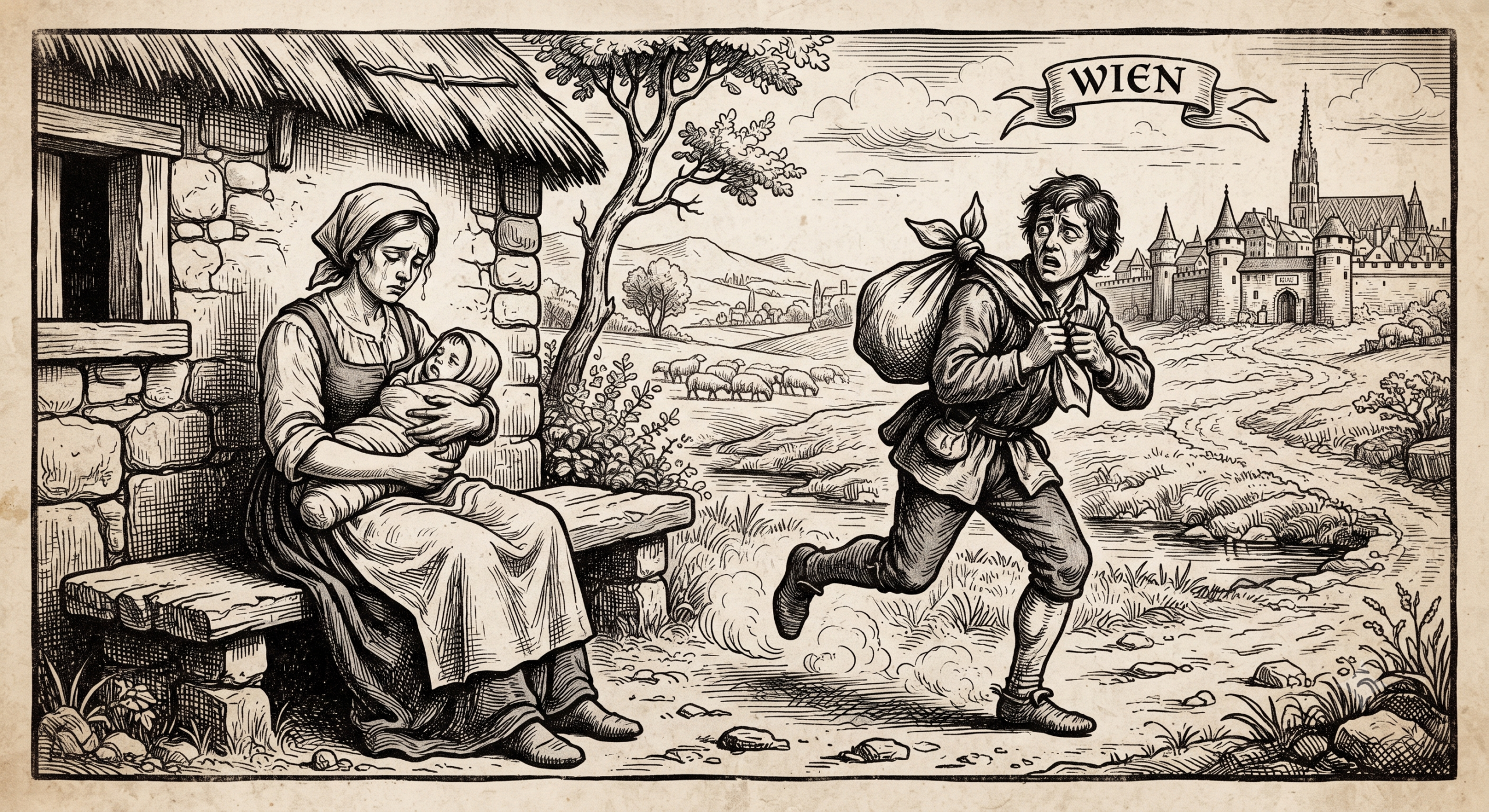
A fundamental milestone in the field of family law in our lands was constituted by the General Civil Code of 1811, by which it was stipulated that parents are obliged to support their children regardless of whether they were born within or outside of marriage. The amount of alimony was based on the social status and property conditions of the father, but simultaneously, the possibilities of the mother were taken into account. The costs of childbirth, the puerperium, and subsequently regular monthly benefits were paid by the father until self-sufficiency could be achieved by the child. Law enforcement was carried out through general courts, as a lawsuit for the determination of paternity and the granting of child support had to be filed by the mother. If payment was refused by the father, execution on property or wages was utilized by the courts. In real life, however, debts were ignored and payments were avoided by many fathers, by which mothers and children were plunged into deep poverty. Already in the 19th century, the payment of alimony was evaded by men in various ways. A father by whom child support for an illegitimate child was not wanted to be paid (and the risk of execution or imprisonment for non-payment was feared) simply picked himself up and was moved to another district or to Vienna for work. Without modern registers, the official search for such fathers was rendered lengthy and unsuccessful, so many mothers were left completely destitute. Alimony agreements were also settled out of court. The father could be bought out with a one-time lump sum (the so-called severance pay), which was deposited at the orphan court, and from it, an annuity was gradually paid to the mother or foster parents. Regular monthly or annual installments were presented as another option. Especially in the countryside, it was common that instead of money, goods in kind (grain, clothing, or firewood) were provided by the father.
The democratization of society and an effort to protect the weakest were brought about by the establishment of Czechoslovakia in 1918, which was also reflected in the area of family law. The first systematic efforts by the state to assist mothers were emerged. Guardianship offices (the predecessors of today’s social departments) were established, by which mothers were assisted with the filing of lawsuits and the official enforcement of money. If payment was not made by the father, he was attempted to be actively tracked down by the state apparatus, while in extreme cases of poverty, charity or municipal poor relief had to be stepped in.
Stories about illegitimate children, strict church courts, or the peculiar enforcement of alimony – all of this is written on the yellowed pages of old registers and files. However, the deciphering of period handwriting, Latin, or German notes can be found difficult for a layman. By combining modern research methods, detailed work with historical registers, and archival documents, your roots can be mapped deep into the past. You will be helped by us to discover who your ancestors were, what they did for a living, and where you truly originate from. Let a free consultation be requested via the contact form, email, or WhatsApp.
Kateřina Schneiderová