
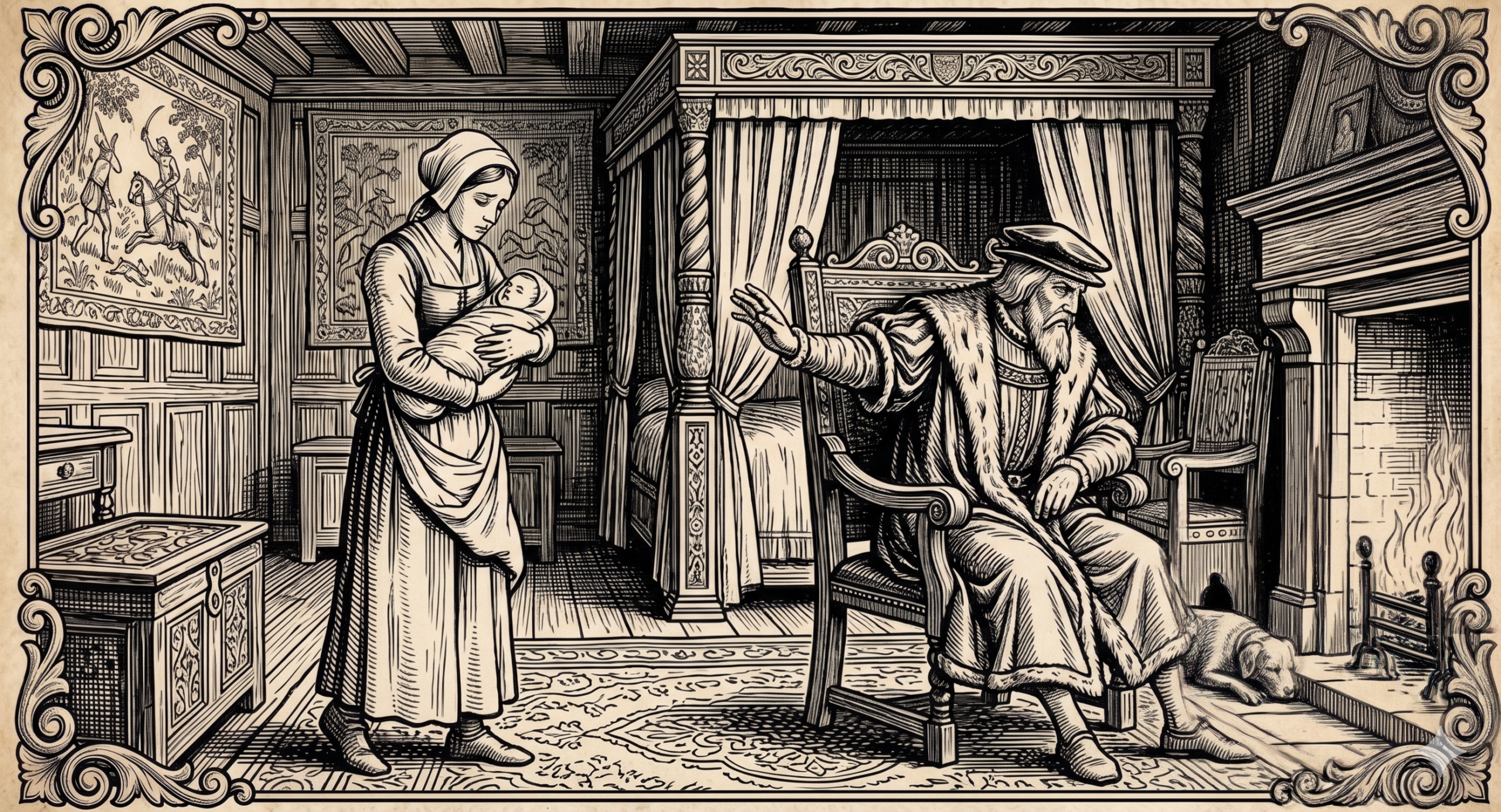
19. Illegitimate Children
In the past, the birth of a child outside of marriage was considered to be a deep social stigma. During times when life was strictly bound by religious and moral rules, the arrival of an “illegitimate child” was not perceived as any reason for celebration. Prejudices, legal restrictions, and harsh social exclusion were faced by illegitimate children and their mothers. From a legal perspective, the position of illegitimate children began to be slightly improved only with the reforms of Joseph II and the subsequent adoption of the civil code, by which the right to maintenance from the father was granted to mothers, provided he was known. Nevertheless, social stigma and contempt were maintained in people’s minds deep into the 20th century.
How was the baptism of an illegitimate child recorded in the register by the priest? Church registers were considered the main official record of a person’s existence, and illegitimate origins were very carefully documented in them by priests. This “sin” had to be made clearly visible for future generations and authorities. Furthermore, the method of entry in the “father” column was changed over the centuries: ranging from mocking remarks by the priest in the 17th century (the father was drowned on the ice, was lost gathering strawberries, ran until he died…) to an empty space or the crossing out of the column at present. Expressions such as spurius (bastard), illegitimus (illegitimate), born from the left side, or from an illegitimate bed were inscribed in the registers. Conversely, the term legitimus (legitimate) was utilized for legitimate children. In certain parishes, a practice was upheld where entries concerning illegitimate children were written at the very end of the register book. Exceptionally, the book was even turned upside down and the entries were kept from the back, so that it would be apparent at first glance that records deviating from the social order were being dealt with.
How were illegitimate children treated by the society of that time? The blame for the transgression against the moral code was fully placed both on the mother and subsequently on the child itself, by whom the consequences were borne throughout its entire life. Unmarried mothers were perceived as “fallen women” (more can be read in the previous article), and illegitimate children were considered to be socially “unclean”. The right to a surname (the mother’s surname was given to it), a coat of arms, or the social status of its biological father was not possessed by the child, and it was completely excluded from inheritance as well. The only path by which social status could be rectified was represented by legitimization through subsequent marriage (legitimatio per subsequens matrimonium). When the biological father of the child was later married by the mother, his paternity was confirmed by the father before the priest and witnesses. Thus, the child was retrospectively rendered legitimate, which was carefully added by the priest to the original entry in the birth register.
What rumors, excuses, and family secrets were accompanied by the birth of an illegitimate child? No opportunity for gossip was missed by the village and town communities. Therefore, various explanations were come up with by mothers and their families so that attention could be diverted from the real (often local) father of the child. Thanks to the employment of such a strategy, humiliating penance in the church was avoided by the family, and the theoretical chance for a later marriage and a decent life was not lost by the girl. Even at present, similar legends are still circulated in many families. “It was a soldier who passed through the region” – armies were constantly moved across Europe, and an encounter with a soldier was paradoxically considered safer to admit because the soldier had long since departed and could not be traced. Certainly, it was often true, but rather this “unknown soldier” was merely used as a cover-up for an affair with a married man. “The fairy tale of blue blood” – when the family of a single mother was conspicuously enriched, it began to be whispered in the neighborhood that a local prince or a high official was actually the father. In some instances, the truth was told by these rumors, as unofficial offspring were occasionally supported secretly by the nobility with financial means. “The priest’s nieces and mysterious orphans” – in the event of an intimate relationship between a priest and a housekeeper, any potential pregnancy and the child had to be concealed at all costs due to the violation of celibacy. Subsequently, these children were presented to the parish and authorities as relatives or poor orphans, by whom the clergyman was taken in out of pure Christian charity. “The foundling on the doorstep” – if a daughter became pregnant unexpectedly, she was hidden in the house by the family during the final months. After the birth, it was then reported by the farmer that an abandoned newborn had been found on the porch, by whom it had been taken in out of goodwill.
Are similar tales about secret fathers, blue blood, or mysterious foundlings circulated in your family too? Old myths can be separated from reality, and reading between the lines of register entries can be done through professional genealogical research. Let the stories that were meant to be forgotten forever be discovered. Let it be found out what is hidden by your family tree, and let your true history begin to be uncovered today! An individual free consultation can be arranged through my web assistant or the contact form at www.rodokmeny-schneider.cz .
Kateřina Schneiderová