
20. Legitimization of an Illegitimate Child
The position of illegitimate children in society was considered very complicated for centuries. A massive social stigma, by which not only the mother but also the child itself was afflicted, was meant by being born outside of marriage. In the registers, the birth records of these children were frequently kept at the very end of the book, being marked with origins from an “illegitimate bed” or from the “left side.” Especially in the 17th and 18th centuries, it was not forgotten by the priest to draw attention to the “sinful transgression” of the woman with a sarcastic remark, such as the mother “had let herself go,” the father “was drowned on the ice,” or “was lost gathering strawberries.” Significantly restricted rights were possessed by illegitimate children (more can be read in the previous article); they could not be fully inherited by them, suitable marriages were found by them with greater difficulty, and they were often forbidden by guild rules from being apprenticed in an honorable trade. Consequently, a change in this status and the elimination of the legal and social abyss were represented by legitimization. It was considered a legal act by which the exact same rights were obtained by the child as if it had been born within a proper marriage.
By what means was the legitimization of an illegitimate child carried out? The most common option was represented by the subsequent marriage of the parents. If the biological father of the child was married to its mother only after the birth, the child was automatically rendered legitimate. Furthermore, another method, which was reserved rather for the higher social classes and the nobility, was constituted by a sovereign’s rescript. It was utilized in cases where a subsequent marriage of the parents was rendered impossible (for example, the mother of the child had died, or an insurmountable class difference existed between the parents by which marriage was prevented). An official request for legitimization had to be submitted to the sovereign by the father. In later centuries (especially from the 19th century onwards), the child of his wife could be formally adopted by a stepfather, by which a family name and inheritance rights were secured for it.
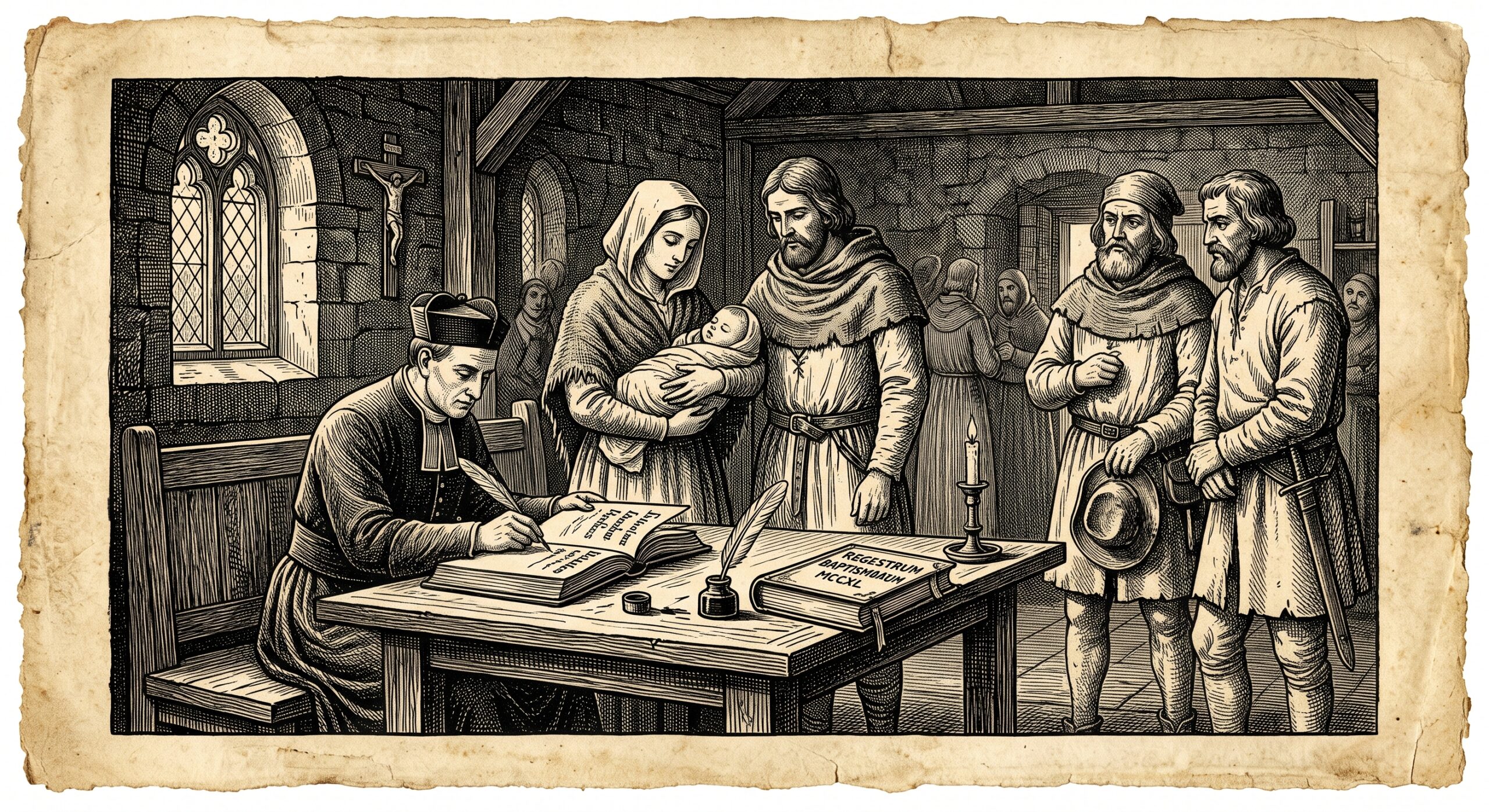
How was legitimization marked in the birth registers? When legitimization occurred (most frequently after the marriage of the parents), the parish was visited by the father accompanied by two witnesses. Subsequently, the entry in the register was adjusted in such a way that the father’s name was added by the priest into the column for the father, which had been left empty at the birth of the child. Into the notes (or directly next to the record), a legitimization clause was added by the priest, by which it was confirmed that the father of the child was claimed by him before witnesses, and that the child was legitimized after the subsequent marriage. Frequently, the exact date of the marriage or the date of this declaration is not omitted. The child, by whom the mother’s maiden name had been borne until then, was given the father’s surname. In the columns by which origin (legitimate/illegitimate) was determined, the record under illegitimate origin was crossed out and rewritten, or it was linked by an arrow to the “legitimate” column.
What impact was had by legitimization on the life of the child and its mother? A fundamentally positive impact on the child’s life was caused by successful legitimization. In the eyes of the law and the church of that time, the “stain of origin” was erased. The path to a full-fledged life was opened for the child. Regarding inheritance rights, a claim to a share of the father’s property was gained by it on the exact same level as any other siblings who were born after the wedding. Access to trades was opened up to it. Previously, “preservation of origin,” i.e., proof of legitimate birth (the so-called certificate of legitimate birth), had been strictly demanded by the guilds. This requirement was fulfilled by the legitimized child, and thus an apprentice and later a journeyman or a master could be become by it. Social prestige was also considered important. The acceptance of the father’s name and integration into a complete family were meant as the end of the social exclusion and mockery by which single mothers and their children had been faced in traditional rural and urban communities.
A story is possessed by every family. However, by far not all fates were found to be straightforward. Illegitimate children, secret marriages, the legitimization of descendants, or blind branches of a lineage – all of this is written on the yellowed pages of old registers. Nevertheless, the deciphering of period handwriting, Latin or German notes, and the understanding of the legal context of the time can be found difficult for a layman. By combining modern research methods, detailed work with historical registers, and archival documents, your roots can be mapped deep into the past. You will be helped by us to discover who your ancestors were, what they did for a living, and where you truly originate from. Let a free consultation be requested via the contact form, email, or WhatsApp.
Kateřina Schneiderová